The
first humans arrived in
Niagara Region almost 12,000 years ago, just in time to witness the
birth of the Falls. The land was different then, consisting of tundra and spruce forest. During this time (the
Palaeo-Indian Period, which lasted until 9,000 years ago),
Niagara was inhabited by the Clovis people. These nomadic hunters likely camped along the old
Lake Erie shoreline,
living in simple, tiny dwellings. They left little to mark their tenure
except chipped stones. These large, fluted projectile points were
likely to fell the caribou, mastodons, moose and elk that roamed the
land.
By 9,500 years ago a deciduous forest apparently covered
southernmost Ontario. This forest supported the hunter-gatherers of the
Archaic Period (9,000
to 3,000 years ago) with a diet of deer, moose, fish and plants. Small
groups hunted in the winter, feeding on nuts and animals attracted to
the forest. Larger groups came together during the summer, setting up
fishing camps at the mouths of rivers and along lakeshores.
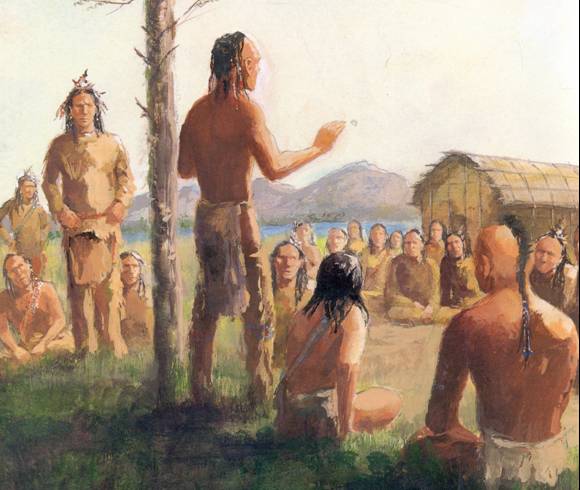
The
Woodland Period lasted from 3,000 to 300
years ago, culminating in the peak of Iroquois culture in southern
Ontario. Corn, bean and squash agriculture provided the main sources of
food. With their bellies full, the
Iroquois had time
for other pursuits and the population boomed. Small palisaded villages
were built, with nuclear or extended families occupying individual
longhouses. During this period, burial rituals and ceramics were
introduced to
Ontario. Society became more complex with a political system based on extended kinship and inter-village alliances.
When the
European explorers and
missionaries arrived at the beginning of the 17th Century, the
Iroquoian villages
were under the direction of various chiefs elected from the major
clans. In turn, these villages were allied within powerful tribal
confederacies.
Unfortunately, inter-tribal warfare with the
Five Nations Iroquois of New York State, made worse by the intrusion of the Europeans, dispersed the three Ontario confederacies, the
Huron,
the Petun and
the Neutral.
Niagara ceased
to be the territory of those who lived in harmony with nature. Still,
this fascinating period of native occupation cries out for
interpretation and study. Since human settlement requires drinking
water, sites within 150 metres of rivers and lakeshores have the
greatest archaeological potential. Palaeo-Indian sites in Niagara would
most likely be associated with the series of relic beach ridges that
once formed the shore of
early Lake Erie.
In May 1535,
Jacques Cartier left France to explore the
New World. Although he never saw
Niagara Falls, the Indians he met along the St.Lawrence River told him about it.
Samuel de Champlain
visited Canada in 1608. He, too, heard stories of the mighty cataract,
but never visited it. Etienne Brule, the first European to see Lakes
Ontario, Erie Huron and Superior, may also have been the first to behold
the Falls, in 1615.
That same year, the
Recollet missionary explorers arrived in
Ontario. They were followed a decade later by the
Jesuits.
It was a Jesuit father, Gabriel Lalemant, who first recorded the
Iroquios name for the river- Onguiaahra, meaning "the Strait". "Niagara"
is a simplification of the original.
In 1651, during the fur- trade rivalry between the
Huron and
Iroquois that was first precipitated by the French, the
Iroquois wiped out the Neutrals. Until the
American Revolution, they managed to keep white settlers out of Niagara almost completely.
In December 1678, Recollet priest Louis Hennepin visited
Niagara Falls. Nineteen years later, he published the first engraving of the Falls in his book Nouvelle Decouverte.
The Falls obviously
made a great impression of Hennepin, for he estimated their height to
be 183 metres, more than three times what it really is.
In 1812, by request of President James Madison, the United States
congress declared war on Canada. Artifacts from that war dot the
riverside, as do monuments erected later, such as the one to Sir Isaac
Brock. Recently, the skeletons of members of the U.S. Army were found
near Old Fort Erie.
Following the
War of 1812, the region began the
slow process of rebuilding itself. Queenston became a bustling
community, but Chippawa was the big centre, with distilleries and
factories.
In the 1820's, a stairway was built down the bank at
Table Rock and the first ferry service across the lower
River began.
By 1827, a paved road had been built up from the ferry landing to the
top of the bank on the Canadian side. This site became the prime
location for hotel development and
the Clifton was built there, after which
Clifton Hill is named.
Niagara has perhaps the most complex transportation history of any area in North America. The first
Welland Canal was completed in 1829. Between 1849 and 1962, thirteen bridges were constructed across the
Niagara River Gorge. Four of them remain.
The roadway between
Niagara-on-the-Lake and
Chippawa was the first designated King's Highway. The first stage coach in
Upper Canada
operated on this roadway between the late 1700s and 1896. The first
railroad in Upper Canada opened in 1841 with horse-drawn carriages
running between
Chippawa and
Queenston. In 1854 it was converted to steam and relocated to serve what was to become the
Town of Niagara Falls.
In 1855, John August Roebling, the designer of the Brooklyn
Bridge, built the Niagara Railway Suspension Bridge, the first bridge of
its type in the world. Between the late 1700s and the middle 1800s,
boats were the main way to get to
Niagara Falls. By 1896, three boats plied the route between Toronto and Queenston.
One of the first electrified street car services was provided in
Niagara, and in 1893 the
Queenston/Chippawa Railway carried boat passengers from Queenston to Table Rock and beyond. In 1902, a railway was constructed across the
Queenston Suspension Bridge. Later it was extended along the lower Gorge on the American side of the River, connecting back into Canada at the
Upper Arch Bridge.
This transit line, the Great Gorge Route, continued in service until
the Depression. The use of boats declined as tourists increasingly chose
to visit Niagara by automobile, bus or train.
Tourism travel to the Falls began in the 1820s and within 50 years it had increased ten-fold to become the area's dominant industry.
After World War 1, automobile touring became popular. As a response,
attractions and
accommodations sprang up in strip developments, much of which still survives.


 After arriving in your room, check for the following: